
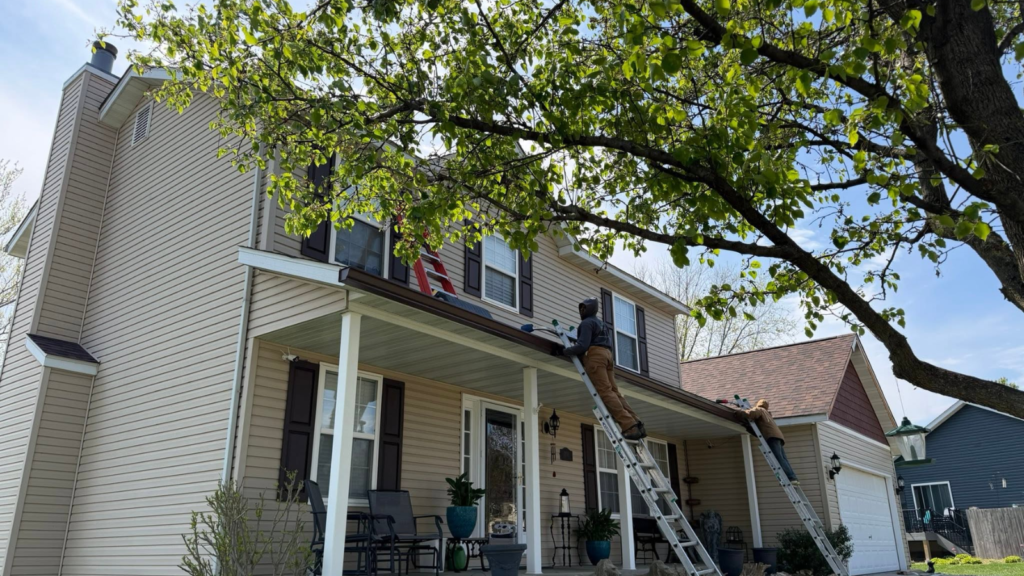
Trees add beauty, shade, privacy, and character to residential properties throughout Columbia, Illinois, and surrounding communities. Mature trees can make a neighborhood feel established, create comfortable outdoor spaces, and complement a home’s landscaping.
However, trees growing too close to a house can also create roofing concerns.
Overhanging branches, falling limbs, accumulated leaves, and excessive shade may affect roofing materials over time. During severe thunderstorms, strong winds can cause branches or entire trees to fall, potentially damaging shingles, gutters, flashing, and structural components.
Understanding how tree-related roof damage develops can help homeowners recognize warning signs, address problems early, and protect their roofing systems without unnecessarily removing healthy trees.
At Diamond Roofing & Exteriors, we serve homeowners throughout Columbia, Waterloo, Alton, Bethalto, Godfrey, Chesterfield, Crystal City, Farmington, Festus, Herculaneum, Hillsboro, Mehlville, Oakville, Pevely, St. Charles, and St. Peters.
Our region experiences changing seasonal conditions, including heavy rainfall, thunderstorms, strong winds, hail, falling leaves, and occasional winter ice and snow. These conditions can increase the risks associated with trees near residential roofs.
Why Trees Can Become a Roofing Concern
Trees and roofing systems can coexist successfully when branches are properly maintained and potential hazards are addressed.
Problems often develop when trees grow too close to the roof or when damaged branches remain above the home.
Common concerns include:
- Falling branches during storms
- Limbs rubbing against shingles
- Leaves accumulating in roof valleys
- Clogged gutters and downspouts
- Excessive shade and moisture retention
- Moss or algae growth
- Damage to flashing and roof vents
- Structural impacts from falling trees
Not every tree near a home creates a serious roofing risk.
However, understanding the relationship between trees and roofing materials can help homeowners determine when professional attention is appropriate.
Understanding Tree-Related Roof Damage
Tree-related roof damage refers to roofing problems caused or influenced by nearby trees, branches, leaves, and other organic debris.
Some damage happens suddenly.
For example, a large branch may fall during a thunderstorm and break shingles or decking.
Other problems develop gradually.
A branch repeatedly rubbing against the roof may wear protective granules from asphalt shingles.
Leaves accumulating in roof valleys may interfere with drainage and keep roofing surfaces damp.
The severity depends on the tree’s condition, distance from the home, roof material, weather exposure, and maintenance history.
Recognizing these differences is important because each problem may require a different solution.
1. Falling Branches During Severe Storms
One of the most obvious risks associated with trees is falling branches.
Strong winds can break limbs, particularly when branches are weakened by decay, previous damage, or structural defects.
Even healthy branches may fail during sufficiently severe weather.
When a branch strikes the roof, it may damage:
- Asphalt shingles
- Metal roofing panels
- Ridge caps
- Flashing
- Roof vents
- Gutters
- Roof decking
The extent of damage depends on the branch’s size, weight, and impact location.
A small branch may cause localized shingle damage.
A larger limb may affect multiple roofing components or structural framing.
What to Do After a Branch Hits Your Roof
If a branch falls onto your home, prioritize safety.
Do not climb onto the roof or attempt to pull a large branch away.
If electrical lines are involved, stay clear and contact the utility provider.
If structural damage is suspected, keep people away from the affected area and seek qualified assistance.
Once conditions are safe, contact a roofing professional to evaluate the damage.
A professional inspection can help determine whether repairs are sufficient or whether more extensive restoration is necessary.
2. Overhanging Branches Can Damage Shingles
Branches do not have to fall to create roofing problems.
Limbs hanging directly above or touching the roof may move during windy conditions.
Repeated contact can wear away protective shingle granules or damage roofing surfaces.
Over time, this may contribute to premature deterioration.
Homeowners should watch for branches that:
- Touch shingles
- Rub against ridge caps
- Hang over roof valleys
- Extend toward roof vents
- Rest against gutters
Removing problematic branches can help reduce the risk of continued contact.
However, tree trimming should be performed carefully to avoid damaging the tree or creating additional hazards.
3. Leaves and Debris Can Trap Moisture
Falling leaves are a familiar part of autumn throughout Illinois and Missouri.
While leaves may appear harmless, large accumulations can interfere with roof drainage.
Debris commonly collects in:
- Roof valleys
- Behind chimneys
- Around skylights
- Near dormers
- Along roof edges
- Inside gutters
When wet leaves remain on roofing surfaces, they can retain moisture.
This may increase exposure to damp conditions and contribute to deterioration of vulnerable materials.
Regular debris removal is an important part of preventing tree-related roof damage.
4. Clogged Gutters Create Drainage Problems
Gutters collect rainwater from the roof and direct it toward downspouts.
However, leaves, twigs, seed pods, and other tree debris can block the system.
When gutters become clogged, water may overflow.
Potential consequences include:
- Fascia moisture damage
- Soffit staining
- Siding deterioration
- Landscaping erosion
- Water accumulation near foundations
- Excessive gutter weight
Clogged gutters do not automatically cause structural damage, but repeated overflow can expose exterior materials to unnecessary moisture.
Homeowners should monitor gutter performance during rainfall and arrange cleaning when needed.
5. Excessive Shade and Roof Moisture
Trees provide valuable shade during warm weather.
However, dense tree coverage can also reduce sunlight reaching certain roof slopes.
Shaded areas may dry more slowly after rainfall or morning dew.
When combined with debris accumulation and poor drainage, prolonged damp conditions may encourage biological growth.
Shade alone does not mean a roof will deteriorate prematurely.
The concern is how moisture, debris, and existing roof conditions interact.
6. Moss Growth on Roofing Materials
Moss tends to favor damp, shaded environments.
It may develop on roofing surfaces where moisture remains available.
Heavy moss growth can interfere with normal drainage and may contribute to material deterioration.
Homeowners should avoid aggressively scraping shingles or using high pressure washing equipment.
Improper cleaning can damage protective granules and roofing surfaces.
A roofing professional can recommend suitable cleaning or corrective measures based on the material and condition.
7. Algae Growth and Roof Discoloration
Dark streaks on asphalt shingles may be associated with algae growth.
Algae discoloration is often primarily an appearance concern, although it should be distinguished from other roofing problems.
Trees can contribute to shaded, moisture retaining conditions that favor biological growth.
However, algae does not necessarily indicate structural damage.
Homeowners should avoid assuming that every dark streak requires roof replacement.
Professional evaluation can help determine whether cleaning, maintenance, or other work is appropriate.
8. Tree Limbs Can Damage Gutters and Downspouts
A falling branch may bend gutters or loosen attachments.
Branches rubbing against gutters can also create wear over time.
Damaged gutters may:
- Sag
- Separate from fascia
- Leak at joints
- Hold standing water
- Overflow during rainfall
Because gutters work closely with the roof, their condition should be considered when evaluating tree-related roof damage.
Repairing shingles without addressing damaged drainage components may leave the home exposed to additional moisture problems.
9. Tree Debris Can Affect Roof Valleys
Roof valleys carry concentrated runoff from adjoining roof slopes.
Leaves and small branches can accumulate in these areas.
If debris obstructs water movement, moisture may remain on roofing materials longer than intended.
Roof valleys should be evaluated during routine maintenance, particularly when mature trees surround the property.
Homeowners should not climb onto steep roofs to remove debris themselves.
10. Trees Can Affect Roof Flashing
Flashing protects vulnerable roofing intersections.
Common locations include:
- Chimneys
- Skylights
- Sidewalls
- Dormers
- Roof valleys
- Plumbing vents
Falling branches can bend or displace flashing.
Debris accumulation may also conceal existing flashing problems.
If water stains appear near these areas after storms, professional inspection can help identify the source.
11. Roof Vents May Be Vulnerable to Falling Debris
Roof vents support ventilation and protect openings in the roofing system.
Branches can damage vent covers or surrounding flashing.
A damaged vent may allow water or debris to enter.
Homeowners should check for visibly displaced components after significant storms.
Professional repair may involve replacing the damaged vent or correcting surrounding roofing materials.
12. Large Trees Can Cause Structural Roof Damage
The most serious tree-related incidents involve large limbs or entire trees falling onto homes.
These impacts can affect more than visible shingles.
Potential damage may include:
- Broken roof decking
- Damaged rafters
- Compromised trusses
- Displaced framing
- Ceiling damage
- Structural movement
If the roof appears to be sagging or the structure has shifted, do not enter the affected area.
Structural damage requires evaluation by appropriately qualified professionals.
Roofing repairs should not proceed until the structure is safe.
Signs of Tree-Related Roof Damage
Homeowners should inspect their properties safely from the ground after significant weather.
Warning signs may include:
- Missing shingles
- Broken branches on the roof
- Visible impact marks
- Damaged ridge caps
- Bent gutters
- Loose flashing
- Accumulated roof debris
- New ceiling stains
- Water dripping inside
- Sagging roof sections
Some problems may not be visible from the ground.
If a large branch struck the roof or other significant damage is suspected, professional inspection is appropriate.
How to Inspect Your Roof Safely
A basic visual inspection can help homeowners identify obvious concerns.
Begin by walking around the property.
Look at the roof from several safe locations.
Check the yard for fallen roofing materials and branches.
Examine gutters, downspouts, siding, and accessible interior areas.
Do not climb onto the roof, especially after rain or storms.
Roofing surfaces can be slippery, and hidden damage may create additional hazards.
Check the Attic for Moisture
If your attic is safely accessible, inspect it for signs of water intrusion.
Look for:
- Damp insulation
- Water stains
- Wet decking
- Dripping
- Musty odors
- Unusual daylight through openings
Moisture in an attic can have several causes, including roofing leaks, condensation, or ventilation concerns.
Professional diagnosis is important before selecting a repair.
When Should You Schedule a Roof Inspection?
A professional inspection may be appropriate when:
- A branch has struck the roof
- Shingles are missing
- Gutters have been damaged
- New leaks appear
- Debris repeatedly collects in valleys
- Branches have been rubbing against shingles
- A large tree near the home appears unstable
An inspection helps determine whether the roofing system remains serviceable.
Not every inspection results in a recommendation for repairs.
Repairing Tree-Related Roof Damage
The appropriate repair depends on the type and extent of damage.
Localized problems may be corrected without replacing the entire roof.
Possible repairs include:
- Replacing damaged shingles
- Repairing flashing
- Replacing damaged roof vents
- Correcting gutter attachments
- Repairing localized decking damage
- Addressing roof edge components
A contractor should inspect surrounding materials to determine whether additional deterioration is present.
When Shingle Repair Is Enough
A small branch may damage only a limited number of shingles.
If the surrounding roofing materials remain in good condition, a targeted repair may be appropriate.
The contractor should evaluate:
- Shingle condition
- Roof age
- Damage extent
- Material compatibility
- Underlying decking
- Nearby flashing
A localized repair may restore the affected area without requiring complete replacement.
When Roof Replacement May Be Necessary
Roof replacement may deserve consideration when damage is extensive.
Examples include:
- Widespread shingle damage
- Multiple impact locations
- Significant underlying deterioration
- Extensive decking damage
- Recurring leaks
- Advanced roof aging
However, not every branch impact requires complete replacement.
The decision should be based on actual conditions.
A professional inspection can help homeowners understand the available options.
Can Tree Damage Affect Metal Roofing?
Yes.
Metal roofing can experience damage from falling branches and other impacts.
Potential concerns include:
- Dented panels
- Scratched protective coatings
- Damaged seams
- Loose fasteners
- Displaced flashing
Some dents may be primarily cosmetic.
Other impacts may affect roofing performance.
A professional should evaluate the specific metal roofing system before recommending repairs.
How Storms Increase Tree-Related Roof Damage
Storms can increase the likelihood of branches breaking or falling.
Strong winds place additional forces on tree limbs.
Heavy rainfall may affect soil stability around certain trees.
Ice accumulation can add weight to branches.
These conditions can contribute to branch failure, particularly when trees already have structural weaknesses.
Homeowners should pay attention to trees near their homes before severe weather arrives.
Tree-Related Roof Damage During Spring
Spring storms may bring strong winds, heavy rainfall, and lightning.
Trees may also have weakened limbs remaining from winter.
Homeowners should inspect nearby trees for:
- Dead branches
- Broken limbs
- Hanging branches
- Visible trunk damage
- Branches touching the roof
A qualified tree care professional can evaluate potential hazards.
Summer Tree Risks
Summer thunderstorms can produce strong winds and heavy rainfall.
Trees with dense foliage may experience substantial wind forces.
Branches hanging above roofs can create additional concerns during severe weather.
Summer is a useful time to review tree growth and identify limbs that may require professional pruning.
Fall Leaves and Roofing Problems
Autumn creates significant debris management challenges for homes surrounded by mature trees.
Leaves may accumulate in gutters, valleys, and roof edges.
Regular cleaning helps maintain drainage.
Homeowners should monitor gutters after periods of heavy leaf fall.
If water repeatedly overflows despite cleaning, the system may also have alignment or capacity problems.
Winter Ice and Tree Branches
Winter conditions can add weight to tree limbs through snow and ice accumulation.
Branches may break under excessive loading.
Falling ice covered limbs can damage roofing materials, gutters, and exterior components.
Homeowners should avoid standing beneath heavily loaded branches.
Do not attempt to shake ice from large limbs or remove hazardous branches yourself.
Preventing Tree-Related Roof Damage
Preventive maintenance is often more practical than waiting for a major problem.
Homeowners can reduce risk by:
- Monitoring tree growth near the home.
- Arranging professional pruning when needed.
- Removing hazardous dead limbs.
- Keeping gutters clear.
- Monitoring roof valleys.
- Inspecting after major storms.
- Addressing existing roof damage promptly.
- Scheduling professional evaluations when concerns appear.
These steps cannot eliminate every risk, but they can help reduce avoidable exposure.
How Far Should Tree Branches Be From the Roof?
There is no single clearance distance that is appropriate for every tree and property.
The ideal separation depends on:
- Tree species
- Branch size
- Growth pattern
- Roof design
- Wind exposure
- Tree health
- Local conditions
Branches should not continuously rub against roofing materials.
A qualified arborist can recommend pruning that provides appropriate clearance without unnecessarily damaging the tree.
Why Professional Tree Trimming Matters
Tree pruning requires knowledge of tree structure and safe cutting practices.
Improper pruning can weaken branches, damage trees, or create additional hazards.
Large limbs may also fall unpredictably during removal.
Homeowners should hire appropriately qualified tree care professionals for hazardous or difficult work.
Roofing contractors can evaluate roof damage, but tree health and pruning decisions are best handled by arborists.
Should You Remove Trees Near Your House?
Not every tree near a home needs to be removed.
Healthy trees can provide shade, privacy, and landscaping benefits.
Removal may be appropriate when a qualified professional identifies serious structural defects, disease, instability, or unacceptable risk.
The decision should consider tree health, location, property conditions, and available risk reduction options.
Pruning may be sufficient in some situations.
Can Tree Roots Damage Your Roof?
Tree roots do not normally affect roofing materials directly.
However, roots may influence nearby soil, landscaping, drainage, or certain structures under specific conditions.
These concerns are different from direct roof damage caused by branches and debris.
Homeowners should avoid confusing foundation or drainage problems with roofing damage.
Gutter Guards and Tree Debris
Gutter guards may help reduce the amount of certain debris entering gutters.
However, they do not eliminate maintenance.
Leaves and other materials can still collect on top of guards or around drainage openings.
Homeowners should choose products based on their property conditions and understand the maintenance requirements.
Gutter guards also cannot prevent falling branches from damaging the roof.
Why Roof Cleaning Requires Care
Removing leaves and debris can help maintain roofing performance.
However, improper cleaning may damage shingles.
Avoid:
- High pressure washing
- Aggressive scraping
- Walking unnecessarily on roofing surfaces
- Using unsuitable chemicals
- Pulling branches across shingles
Professional cleaning methods should be appropriate for the roofing material and manufacturer guidance.
The Role of Gutters in Roof Protection
Gutters help direct water away from roof edges and vulnerable exterior areas.
When tree debris blocks drainage, water may overflow.
Repeated overflow can expose fascia, soffit, siding, and foundation areas to moisture.
Keeping gutters functional is an important part of preventing tree-related roof damage and related exterior problems.
How Trees Affect Roof Longevity
Trees do not automatically shorten a roof’s lifespan.
A properly maintained tree can coexist with a well installed roofing system.
However, repeated branch contact, debris accumulation, moisture retention, and storm impacts may contribute to premature wear.
The overall effect depends on the roof’s material, installation quality, maintenance, and exposure.
Preventive care helps reduce unnecessary stress on roofing components.
Roof Age and Tree Damage
An older roof may already have deteriorated shingles or flashing.
Tree impacts can affect weakened materials differently from newer roofing systems.
However, a newer roof is not immune to falling branches.
Homeowners should evaluate actual damage rather than relying only on roof age.
Insurance Considerations After Tree Damage
Homeowners insurance may cover certain sudden damage caused by falling trees or branches, depending on the policy and circumstances.
Coverage may depend on:
- Cause of damage
- Policy terms
- Exclusions
- Deductibles
- Maintenance related considerations
- Insurer determination
Homeowners should document visible damage and review their insurance policy.
A roofing contractor can assess the roof and provide repair information, but the insurer determines coverage.
What to Document After a Tree Falls
If a tree or large branch damages your roof, document the situation when it is safe.
Useful records include:
- Date of the incident
- Photographs of the fallen tree or branch
- Visible roof damage
- Interior water stains
- Damaged gutters
- Emergency protection work
- Contractor inspection findings
- Repair estimates
Do not delay emergency safety measures simply to take photographs.
Emergency Roof Protection After Tree Damage
Severe tree impacts may expose roofing materials or create openings.
Temporary protection may be necessary to reduce additional water intrusion.
However, damaged structures can be unstable.
Emergency work should be performed by qualified professionals using appropriate safety procedures.
Temporary coverings are not substitutes for permanent repairs.
Why Prompt Repairs Matter
Leaving damaged roofing materials exposed can increase the risk of additional moisture intrusion.
Rain may reach decking, insulation, ceilings, or other building materials.
The appropriate response depends on the extent of damage.
A minor problem may require a targeted repair.
A significant impact may require structural evaluation and more extensive restoration.
Timely professional assessment helps determine the correct next steps.
Tree-Related Roof Damage and Home Resale
Visible roof damage can raise concerns during a home sale.
Potential buyers may notice missing shingles, staining, sagging gutters, or branches touching the roof.
Addressing known problems and keeping maintenance records can help demonstrate that the property has been cared for.
However, roofing improvements do not guarantee a specific increase in resale value.
Questions to Ask Your Roofing Contractor
If you suspect tree damage, ask:
- What roofing materials were affected?
- Is the damage localized or widespread?
- Is the roof decking damaged?
- Are there structural concerns?
- Can the roof be repaired?
- Is replacement necessary?
- Were gutters or flashing affected?
- What materials will be used?
- What are the estimated costs?
- What warranty terms apply?
Clear explanations can help homeowners make informed decisions.
Questions to Ask a Tree Care Professional
When evaluating trees near your home, consider asking:
- Are any branches structurally weak?
- Are there signs of decay?
- Which limbs pose the greatest risk?
- Can pruning reduce the hazard?
- Is tree removal necessary?
- How should branches be trimmed without harming the tree?
- How frequently should the tree be evaluated?
A qualified arborist can help homeowners balance tree preservation with property safety.
A Practical Tree and Roof Maintenance Checklist
Use this checklist throughout the year:
- Inspect nearby trees from the ground.
- Look for dead or broken limbs.
- Check for branches touching shingles.
- Monitor tree growth near roof vents.
- Keep gutters and downspouts clear.
- Watch for debris in roof valleys.
- Check for visible shingle deterioration.
- Inspect after severe storms.
- Look for interior water stains.
- Arrange professional pruning when needed.
- Schedule roof repairs promptly.
- Keep maintenance records.
Consistent attention can help reduce the risk of tree-related roof damage.
Why Local Experience Matters
Homes throughout Columbia and surrounding Illinois and Missouri communities experience seasonal storms, strong winds, rainfall, and changing temperatures.
Mature trees are common in established neighborhoods, and their proximity to homes can create unique roofing concerns.
A local roofing contractor familiar with regional weather and residential roofing systems can help evaluate damage and recommend appropriate solutions.
Serving Columbia and Surrounding Communities
Diamond Roofing & Exteriors serves homeowners throughout Columbia, Waterloo, Alton, Bethalto, Godfrey, Chesterfield, Crystal City, Farmington, Festus, Herculaneum, Hillsboro, Mehlville, Oakville, Pevely, St. Charles, and St. Peters.
Whether you have overhanging branches in Columbia, clogged gutters in Waterloo, storm damaged shingles in Festus, or concerns about mature trees near your home in St. Charles, understanding tree-related roof damage can help you protect your property.
Every home is different.
Tree size, roof design, roofing materials, and weather exposure all influence the appropriate maintenance approach.
Why Choose Diamond Roofing & Exteriors?
At Diamond Roofing & Exteriors, we understand that roofing problems can involve more than missing shingles.
Falling branches may affect decking, flashing, gutters, or other exterior components.
Debris accumulation can interfere with drainage.
Repeated moisture exposure may contribute to deterioration around roof edges.
Our services include:
- Roof inspections
- Roof repair
- Roof replacement
- Storm damage restoration
- Metal roofing
- Vinyl siding
- Gutters
- Exterior solutions
We help homeowners evaluate visible roofing concerns and understand whether repair or replacement may be appropriate.
When addressing tree-related roof damage, our goal is to consider the overall condition of the roofing and exterior system rather than focusing only on the most obvious problem.
Final Thoughts
Trees are valuable features of residential landscapes, but they require thoughtful maintenance when growing near a home.
Overhanging branches, falling limbs, clogged gutters, and excessive debris can create roofing concerns.
Some problems develop gradually through repeated contact or moisture exposure.
Others happen suddenly during severe storms.
Understanding tree-related roof damage helps homeowners recognize these risks and respond appropriately.
The most effective approach combines routine observation, professional tree care, gutter maintenance, and timely roofing inspections.
Homeowners should not remove every tree simply because it grows near the house.
Instead, they should evaluate whether branches create contact hazards, whether debris affects drainage, and whether the tree has structural concerns.
A qualified arborist can help address tree health and pruning.
A roofing professional can evaluate damage to shingles, flashing, decking, gutters, and other exterior components.
If a branch has already struck the roof, safety should come first.
Avoid climbing onto damaged roofing surfaces or attempting to remove heavy limbs yourself.
Professional evaluation can help determine whether localized repairs are sufficient or whether more extensive restoration is needed.
For homeowners throughout Columbia, Waterloo, Alton, Bethalto, Godfrey, Chesterfield, Crystal City, Farmington, Festus, Herculaneum, Hillsboro, Mehlville, Oakville, Pevely, St. Charles, and St. Peters, proactive maintenance can help reduce avoidable roofing concerns throughout the year.
If you have noticed damaged shingles, fallen branches, recurring gutter clogs, or other signs of tree-related roof damage, contact Diamond Roofing & Exteriors to discuss a professional roof evaluation.
